Comparing content creation
The node forms for Basic Pages and Articles look very similar, but Articles have more fields than Basic Pages, and they behave slightly differently:
Article
- Title
- Body
- Tags
- Image
Basic Page
- Title
- Body
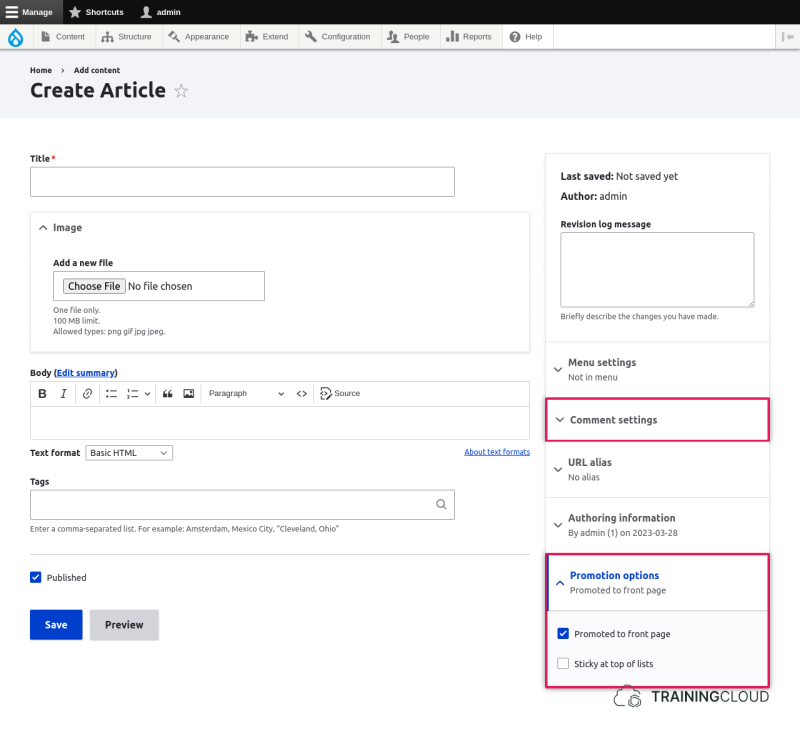
The settings-related fields on the right also look similar, but Articles have an extra 'Comment settings' fieldset, and there's a difference in which settings are selected by default:
Article
- 'Comment Settings' fieldset
- 'Promoted to front page': yes
Basic Page
- No 'Comment settings' field set
- 'Promoted to front page': no
Content display
Articles show a comment form and a list of comments.
Basic Pages don't have commenting enabled at all.
Features
By default, Articles can be commented upon, while Basic Pages cannot.
Feature-wise this is the biggest difference between the two Content Types.
Intended use
Articles are meant for time-sensitive content like news items, press releases and blog posts.
Basic Pages are meant for static-like content, such as 'About us' and 'Terms and Services' pages.
Why Use Multiple Content Types?
We've determined that each content type has its own (default) settings and its own specific fields.
In addition:
- you can restrict persmissions per Content Type (e.g. "Only Managers can create/edit content of the type Report")
- you can use different graphic templates to change the look and feel of each Content Type
- you can create lists of content per Content Type
Activity
Can you explain why Drupal has more than one Content Type? Can't we just use the 'Basic Page' content type for everything, and add all the fields we need?
Technically, it's totally possible to use one single content type for all your content.
However, doing so has many disadvantages, including:
- harder to set up permissions for different kinds of content
- harder to specify different design templates for different kinds of content
- harder to create lists of only one kind of content
Activity
You understand that the Article Content Type is intended for time-sensitive content like news, press releases and blog posts.
However, you encounter a Drupal site that contains the Content Types 'Article', 'Press Release', 'Blog Post', and 'Newsflash'.
What reasons could the developers have to create 4 different Content Types for very similar types of content?
It's possible they want to:
- add different fields to each Content Type
- specify different permissions per Content Type
- create different lists of content (views) per Content Type
- use a different design for each Content Type
Summary
- All Content Types have a common set of fields and settings.
- Most Content Types also all have their own specific fields, settings, and enabled features.
- Each Content Type has its own purpose, and can have its own design template** and permissions such as access control restrictions.